
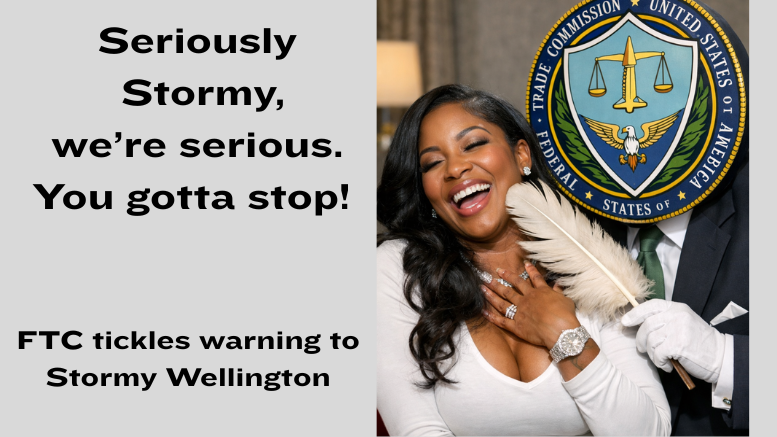
The recent Federal Trade Commission action involving Stormy Wellington has raised an important question across the direct selling and network marketing industry. Did the FTC actually impose meaningful penalties, or did they effectively give her a pass?
After reviewing the official FTC order, the answer is clear. While the case may sound serious on the surface, the reality is that this outcome looks far more like a warning than a punishment.
No Financial Penalties in the FTC Order
One of the most important facts is what is missing from the order. There are no immediate financial penalties.
There is no fine. There is no restitution. There is no requirement to pay back earnings. There is no asset seizure.
In many FTC enforcement actions, especially those involving income claims in MLM or business opportunities, it is common to see multi million dollar judgments or at least suspended financial penalties. That did not happen here.
Instead, the FTC chose to resolve the case without imposing any direct financial consequences.
What the FTC Order Actually Does
The order is a stipulated settlement that focuses entirely on future behavior. It places restrictions on how Stormy Wellington can promote business opportunities going forward.
The FTC order prohibits misleading income claims. It restricts the use of lifestyle marketing that could imply earnings. It requires that any claims about income be truthful, typical, and supported by evidence.
The order also applies broadly to any future business venture, not just one company or opportunity. That includes any MLM, affiliate program, or income based offer she may promote in the future.
In addition, there is a requirement to notify individuals in her network about the order and the FTC’s position on past claims.
No Admission of Wrongdoing
Another key detail is that this was a settlement without an admission of wrongdoing. This is common in FTC cases, but it still matters.
By agreeing to the order, Stormy Wellington avoided a prolonged legal battle while also avoiding any immediate financial hit.
Why This Looks Like a Pass
From a practical standpoint, this outcome can reasonably be viewed as the FTC giving her a pass.
There are no financial penalties. There is no forced shutdown of operations. There is no ban from the industry. There is no repayment to consumers.
Instead, the FTC has put rules in place and is essentially saying that future conduct must comply.
For many observers, especially those familiar with other FTC enforcement actions in the MLM space, this stands out as a lighter approach.
The Real Risk Is in the Future
That said, this is not completely without consequences. The order is a legally binding federal court order.
If the terms are violated in the future, the FTC has the ability to return to court and seek significant financial penalties. At that point, the consequences could be much more severe.
In other words, while there is no immediate punishment, there is now a permanent level of scrutiny.
What This Means for the MLM and Business Opportunity Industry
This case sends a mixed message to the industry.
On one hand, the FTC continues to focus on income claims and marketing practices. On the other hand, the lack of financial penalties may signal that enforcement outcomes can vary significantly depending on the situation.
For network marketers, influencers, and business opportunity promoters, the takeaway is clear. The FTC is watching income claims closely, but not every case results in heavy fines.
Final Thoughts
The FTC action against Stormy Wellington is not nothing, but it is also not the kind of enforcement action many expected.
There are restrictions. There is oversight. There is legal accountability moving forward.
But when it comes to real, immediate penalties, this case falls short of what is typically seen in major FTC crackdowns.
For now, it appears that Stormy Wellington walks away without financial damage, making this case look much more like a warning shot than a true punishment.
Here’s the FTC Order to Stormy Wellington:
https://www.ftc.gov/system/files/ftc_gov/pdf/2523145wellingtonorder.pdf
Hmmm, what’s in store for Eric Worre?
What do you think about MLM. Your opinion counts.
Be the first to comment on "FTC Order Against Stormy Wellington: Did the FTC Really Let Her Off Easy?"