
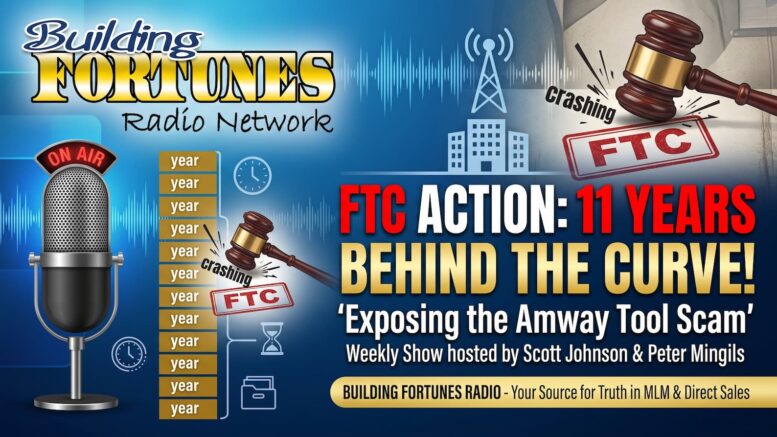
FTC Takes Historic Action Against Amway and Major Affiliates: Why Federal Regulators Are 11 Years Behind the Curve
In an unprecedented regulatory milestone, the Federal Trade Commission (FTC), alongside the State of Washington, announced a historic enforcement action and a proposed $225 million settlement against multilevel marketing giant Amway Corp. and two of its largest training affiliates, World Wide Group (WWG) and Leadership Team Development (LTD).
The action tackles unfair and deceptive practices, misleading earnings claims, forced inventory loading, and the predatory sales of internal training tools and motivation materials.
While federal regulators are celebrating this record recovery, anyone following industry oversight closely knows the reality: the FTC is at least 11 years behind.
For over a decade, Scott Johnson and Peter Mingils have hosted a weekly radio show on the Building Fortunes Radio network dedicated to this exact issue under the banner: Stop the Amway Tool Scam.
Week after week, year after year, Scott Johnson has documented, analyzed, and sounded the alarm on how third-party motivation and training systems exploit Independent Business Owners (IBOs). If you have followed Scott Johnson’s advocacy on his Facebook page at Stop the Amway Tool Scam
, none of the FTC’s findings come as breaking news. They are the exact systemic abuses Scott and Peter have broadcast on air for 11 straight years.
Inside the Historic $225 Million FTC Action Against Amway
The joint complaint filed by the FTC and Washington State in the U.S. District Court for the Western District of Washington marks the largest monetary judgment ever collected from an MLM operator. Under the proposed settlement order, Amway, WWG, and LTD have agreed to pay $225 million, with the vast majority allocated directly as redress for harmed participants.
The complaint outlines a systematic pattern of deceptive conduct centered around recruitment, exaggerated income claims, and coercive tool sales:
- Deceptive Earnings Representations: Affiliates recruited prospective distributors with claims that they could easily earn $40,000 or more per year, replace full-time jobs, and achieve early retirement. In reality, the FTC found that only about 1% ever reached that income level, and the vast majority of recruits who joined WWG or LTD after 2020 lost money.
- Coercive Tool and Training Sales: Approved provider groups such as WWG and LTD charged IBOs thousands of dollars per year for seminars, audio streams, books, and coaching, marketing them as essential for business success.
- Internal Consumption and Inventory Loading: Rather than cultivating genuine retail demand, the systems pressured participants to purchase set amounts of Amway products monthly, regardless of personal need or customer demand, creating closets full of overpriced goods.
- Falsified Retail Sales: The FTC alleges participants were actively instructed to report fake retail transactions to maintain the illusion that revenues stemmed from legitimate consumer sales rather than recruitment and internal volume requirements.
The New Operational Mandates Under the Proposed Order
In addition to the $225 million financial judgment, the federal settlement imposes strict behavioral injunctions on Amway, WWG, and LTD:
- Strict 70% Retail Resale Rule: IBOs must verify that at least 70% of all purchased products are genuinely resold to retail customers each month before bonuses can be awarded.
- Recruiter Compensation Penalties: Up-line sponsors will see dramatic compensation reductions if their recruited down-lines simply purchase inventory without reselling it to end consumers.
- End-Customer Receipts Sent by Corporate: IBOs must submit verified sales reports including exact transaction prices, and Amway must deliver receipts directly to retail buyers.
- Zero-Cost First Year for Training Materials: Approved affiliates (including WWG and LTD) are expressly prohibited from charging new recruits any fees for training, mentoring, or motivational tools during their first 12 months.
- Termination for Falsifying Records: Amway must immediately terminate distributors who submit fake sales receipts or coach others to do so.
- Independent External Audits: Amway’s internal retail sales records and compliance mechanisms will be subject to regular independent third-party audits.
11 Years on the Airwaves: The “Stop the Amway Tool Scam” Show
Federal regulators may treat this enforcement action as an unexpected revelation, but the paper trail tell a different story.
For 11 continuous years, Peter Mingils and Scott Johnson have analyzed the inner workings of Amway, WWG, LTD, and the lucrative secondary business commonly known across the network marketing sector as the “tool scam.”
Through their weekly broadcast on Building Fortunes Radio, Johnson and Mingils detailed:
- How the true profits for top-tier leaders frequently came not from retail sales of soap and vitamins, but from high-margin convention tickets, audio subscriptions, and motivational literature.
- How new participants were pressured into continuous auto-ship orders for products that were priced far higher than comparable retail alternatives.
- How the systemic culture of these organizations shamed participants who questioned the profitability of buying hundreds of dollars in training materials every single month.
Scott Johnson’s extensive documentation and community outreach on the Stop the Amway Tool Scam Facebook page
provided a direct refuge and educational clearinghouse for former IBOs seeking to untangle how they were misled.
A Wake-Up Call for the Entire Multilevel Marketing Industry
The FTC’s complaint against Amway and its affiliated training organizations should serve as a stark warning to direct selling companies everywhere:
1. The Secondary Training Business Model Is Under Direct Scrutiny
For decades, direct selling operators looked the other way while elite distributors created separate corporate entities to sell expensive software, app subscriptions, leads, and event tickets to their downlines. By holding Amway accountable alongside WWG and LTD, regulators have signaled that companies can no longer distance themselves from the actions of their top distributor organizations.
2. Verifiable Retail Sales Are Non-Negotiable
The days of relying on internal consumption to satisfy regulatory standards are coming to an end. Regulators are demanding audited proof that products are reaching retail end-users who have no financial stake in the business opportunity.
3. Accountability Follows Persistent Exposure
While administrative agencies often move at a glacial pace, sustained consumer education matters. Grassroots investigative radio programming and consumer advocacy kept these issues visible long enough to force federal and state enforcement agencies to intervene.
Listen and Stay Informed on Building Fortunes Radio
For continued commentary, deep-dive interviews, and archival coverage of this landmark Amway enforcement action, tune in to Building Fortunes Radio.
Follow the ongoing discussions, review source materials, and connect with Scott Johnson directly by visiting the Stop the Amway Tool Scam Facebook Page
.
Be the first to comment on "Scott Johnson was right about Amway and it Took FTC 11 Years to Catch up"